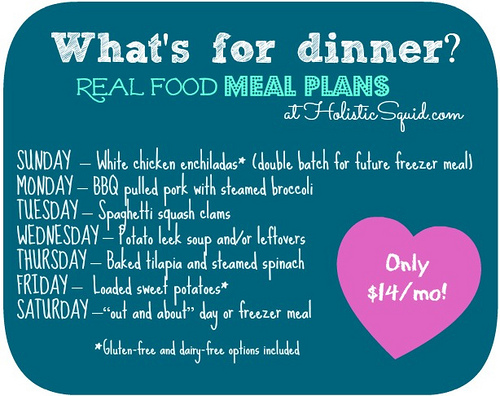
If you're busy or on a budget (or both), meal planning is a must. Throwing together meals at the last minute can be fun and I highly recommend doing it on occasion just to bring a flavor of spontaneity into your life. But if you're like most folks, waiting till the last minute often means you're too tired or frazzled from a long day to brainstorm a creative meal--and then spontaneity ends up looking like cold sandwiches or take out... again.
But what if you can't spend time every week planning real food meals and coordinating your shopping list? Get someone else to do it for you!
While I have my own set of unique talents, I confess I'm not a very creative cook or meal planner. It can help to borrow someone else's expertise in this department--someone who has experience cooking real food meals and has already done all the planning for me. Luckily, I found someone who does this!
Emily at Holistic Squid just introduced her weekly real food meal plans, complete with a shopping list and special options if you need gluten-free or dairy-free meals. She includes bonus recipes every week, too, so you always have plenty of real food on hand--so no more unplanned take out meals!
Read on below to find out how you can win a free year of weekly meal plans. And even if you don't win, we'll be offering a special coupon code after the giveaway so you can enjoy these great meal plans at a discounted price!
Enter to Win One Year of Real Food Meal Plans ($72 Value)
This whipped coconut oil recipe is the perfect moisturizer for summertime (or when you wish it was summertime!). Key lime pie is one of my favorite desserts, so it comes as no surprise that I rather enjoy smelling like key lime pie in the mornings after applying this whipped moisturizer. The sweet, tangy combination of lime and lemon essential oils brightens my mood, lifts my spirits, and makes me dream of lying in the sun on a tropical beach somewhere--even if it's below freezing outside!
A New and Improved Whipped Coconut Oil Recipe
My key lime coconut oil recipe contains a few extra ingredients that weren't in my original whipped coconut oil body butter recipe. One is a small amount of liquid oil, such as olive oil or castor oil. (I recommend a low-PUFA oil because vegetable oils aren't your friend--either in your body or on your skin). Another is aloe vera gel, which is soothing to the skin, and great for treating acne, wrinkles and scars. Both the liquid oil and the aloe vera gel keep the coconut oil on the softer side (even in frigid temperatures).
The lemon and lime essential oils not only give this whipped moisturizer its tantalizingly indulgent aroma, but they have beneficial properties as well. Both citrus oils have antiseptic, antiviral, antibacterial, disinfectant, and astringent properties. I notice they combine well with the moisturizing properties of coconut oil, and tend to keep it from feeling excessively greasy--a common complaint about using coconut oil as a moisturizer. The skin on my face absolutely glows after using this combination!
I'm quite impressed with the results, and am secretly pleased that this coconut oil recipe easily outperforms an expensive facial cream I tried recently. Just imagine: a facial moisturizer that contains only food-based ingredients and costs pennies on the dollar compared to department store creams. What's not to love?
Key Lime Whipped Coconut Oil Body Butter Recipe
Ingredients (Makes About 1 Cup of Whipped Coconut Oil)
1. Place all ingredients into a mixing bowl. Note: Do not melt the coconut oil first. It will only whip up if it's solid.
2. Mix with an electric mixer on high speed with a wire whisk attachment for 3-7 minutes or until whipped into a light, airy consistency. (After 3 minutes, check back every minute or so until it reaches the right consistency.)
3. Spoon the whipped coconut oil body butter into a glass jar and cover
tightly. Store at room temperature, or in the refrigerator if your
house is so warm it melts the oil.
Tip: An electric hand mixer will work, but my KitchenAid stand mixer did the job quickly and easily with little effort on my part (love it!). A blender or food processor will not work with this coconut
oil recipe, because they tend to warm the oil too much and prevent it
from whipping up. If your coconut oil is too soft to whip, try putting the bowl in the freezer for a few minutes before mixing.
If you had a time machine, what would you do? Well, a number of things come to mind, but I would definitely pop back in time to December 2003 and hand myself a copy of the new Beautiful Babies book.
See, the me in 2003 had just announced to my husband that we were expecting our first baby. We were excited, scared and totally clueless--especially about the importance of nutrition.
Luckily I went through a Bradley birthing class which at least told me to eat enough protein (good tip!). But I was still seriously lacking in the foundational principles of how nutrition affects fetal development. I didn't know my baby needed a nutrient-dense diet to develop straight teeth, balanced gut flora and a healthy brain. I didn't know about butter or coconut oil or raw milk.
But a few years later--after the birth of my daughter and then later my son--I finally learned about real food nutrition. It blew my mind. And that's about the time I started wishing for a time machine.
Of course, since time machines don't exist (yet--call me if you figure out that whole space time continuum thing), I figure the best I can do is reach out to future mothers. Enter Beautiful Babies.
What Beautiful Babies is All About
Did you know that simple changes in your diet can increase your fertility, lower your chance of experiencing morning sickness, and even minimize the chance your child will ever need braces? Kristen Michaelis of Food Renegade discusses all of this and more in her new book Beautiful Babies. In the forward, Joel Salatin says,
"I find Kristen’s feisty spirit and mischievous humor both empowering and
liberating. As a dad of two, husband of one, and grandfather of three, I
covet these historically proven and normal principles for every family
on earth. I wish this book had been around when my wife, Teresa, and I
were starting our family."
I know how you feel, Joel!
Kristen also offers Beautiful Babies in an incredible 12-week online class featuring videos, a downloadable workbook, and plenty of supplemental reading materials. All meant to help you learn how to nourish your body and your baby during conception, pregnancy, breastfeeding and beyond.
Now, normally the Beautiful Babies class retails for $199. But right now, Kristen is offering a special deal for anyone who pre-orders the new paperback book: FREE enrollment in the Beautiful Babies online class! So for the price of a paperback, you'll be getting a crazy good deal on the class.
So if you (or anyone you know) is trying to conceive, pregnant, breastfeeding, or wondering about the best way to feed their young baby, now is the time to take advantage of everything Beautiful Babies has to offer!
Email your order receipt to booklaunch@foodrenegade.com. After Kristin verifies your order, she'll email you a special coupon for your free enrollement in the class! Q. Can I give the free enrollment as a gift?
A. Definitely! When you enroll in the online class, you can put in your loved one's contact information to enroll them in the course.
What is margarine? It shows up in the food aisle at your local grocery store, but does that make it food? My cats don't think so. And neither do I.
What is Margarine? A Message from the Barn Cats
I don't buy margarine. I used to many, many moons ago (back when I was scared of butter). But now that I know saturated fat is good for you, nary a stick or tub of margarine has entered my kitchen for some years now. That is, until a house guest left a package in the fridge a few weeks ago.
I didn't even realize it until the guest had left. And there it is. A yellow and blue box full of oddly colored yellow sticks of margarine. It doesn't look like the creamy, gold butter of summertime. It's a fake yellow, food-dye yellow. Ick.
I call my husband over to the fridge. "What do we do with it?" I ask.
"Well, we can't eat it," he says. "That's gross."
I am so glad he agrees with me.
"Should we throw it away?" I hesitate. "I hate wasting food."
We stare, deep in thought, at the yellow and blue box.
"We could feed it to the cats?" I finally suggest. But I'm not sure. Would that be right?
We have several barn cats who live outside and protect our chickens from various pests and predators that roam our woods. They love snacking on the occasional scrap food, especially when I am kind enough to pass a little liver, a fresh egg, or shrimp tails their way. Perhaps this explains why they follow me around the yard, making figure eights around my feet as I walk. They want to know if I have any tasty tidbits for them to sample.
But this was different. Margarine could hardly be equated with real food like liver or eggs.
My husband finally answers slowly, "I guess so." He also sounds hesitant. We are not sure if this could be considered animal abuse.
With doubt weighing heavily on my mind, I pull each yellowy stick of margarine from its plastic wrapping and put in into a bowl. Now I love butter, but this clearly isn't butter as it turns my stomach even looking at a whole bowlful of the stuff.
I take the bowl out to my cats, who immediately begin the figure eight ritual in anticipation of their treat. I set the bowl down in front of them, and all of them pounce at the easy prey.
But then they stop. They sniff the margarine gingerly and then look up at me as if to say, "Where's the real food?"
Not even the greediest of my barn cats will take a nibble. I am perplexed, because I have seen these cats eat some strange and rather disturbing things over the years. I decide to leave the bowl and see if they don't develop a hankering for it.
I return two hours later to fetch my empty bowl. Only it isn't empty. In fact, the margarine hasn't been touched at all. I am floored and I bring the bowl back into the house to show my husband.
Neither of us can believe it, but our cats flat-out refused to eat even a nibble of margarine. If only the general population were so wise. We marvel at the instinctual knowledge of wild beasts while I scrape the margarine into the trash can. I vow to never try and feed this fake-food-stuff to my animals ever again.
Sorry barn cats. My bad.
Moral of the story: I now realize you aren't actually wasting food when you throw margarine away. Because what is margarine? The answer is clear: it is not food!
And for all future house guests: if you leave margarine at my house, I will throw it straight into the garbage can and perhaps dare to lecture you on how even my cats won't touch it. I am sure my cats endowed me with this experience for a good reason. I must spread the word about real butter.
Whew, what a way to kick off 2013! January was an exciting month for The Nourished Life. For one thing, I began work on my first eBook The Nourished Metabolism, which will launch sometime in March. This will be a culmination of everything I've learned about metabolic health and wellness during the last five years. Expect some myth-busting, a wee bit of controversy, and a balanced plan for healthy living.
Around the web, my fellow bloggers also posted some great articles and recipes this month. Here are some of my favorites:
Sigh. Nothing can pull a girl's heartstrings like a good recipe for chocolate peanut butter bars. As a lifelong fan of Reese's peanut butter cups, I've always wanted to find a way to indulge my chocolatey peanut buttery cravings at home without having to succumb to mass market candy with all its not-so-lovely additives.
Enter this too-good-to-be-true chocolate peanut butter bar recipe by my fellow blogger Carol at Ditch the Wheat. She obviously understands the magical spell Reese's can hold over you, as well as the age-old struggle between trying to indulge in a decadent dessert and trying to eat better for your health.
I was delighted to discover her latest recipe book Indulge: 70 Grain Free Recipes included a recipe for chocolate peanut butter bars. Not only do these hit the spot perfectly, but the recipe is very friendly to those with allergies or anyone following a grain-free, dairy-free or paleo-style diet.
If you're trying to avoid peanut butter (for allergies or other reasons), or if you just want to give these a creative flair, you can also try making them with almond butter or cashew butter--I imagine homemade macadamia nut butter would be pretty finger-lickin' good, too!
How to Make Grain-Free Chocolate Peanut Butter Bars
Preheat oven to 350°F (177°C). Line the bottom of a 4x8 inch rectangular loaf pan with parchment paper.
In a large bowl combine the ingredients for the crust.
Evenly press the dough into the bottom of the prepared baking pan.
Bake for 10-15 minutes. The crust is done when it is lightly brown and firm to the touch. Let the crust cool before spreading the filling.
In a bowl, combine the nut butter, coconut oil, raw honey. Mix and reserve about ¼ of the mixture for the chocolate topping.
Spread the almond butter filling onto the cooled crust.
Place the bars in the freezer to firm up before spreading the chocolate mixture on top of the almond filling.
To make the chocolate topping add unsweetened cocoa powder to the reserved almond butter filling and sweeten to taste.
Spread on top of the semi-frozen bars. Place in the fridge to firm. Store the bars in the refrigerator.
Makes 8 servings
Easy peasy, aren't they? If you're ready to try more grain-free, primal-friendly dessert recipes, then you'll want to check out Indulge: 70 Grain Free Desserts. You'll get:
Over 70 + recipes that include nut free & egg free recipes
162 pages of content
All recipes are dairy free and adhere to Paleo principles
Hyperlinked table of contents makes navigating easy
Learning to eat to increase your metabolism can be a long and complicated journey. At least, that's what I used to think. It turns out the solution might be a lot more simple than I previously thought.
I'll admit, I've tried a lot of the typical "tricks" to increase my metabolism. You've probably heard of them. Eat more protein. Drink tons of water. Fidget a lot. Hit the treadmill. Take hot baths. Eat a lot of cayenne pepper.
Some of these are founded in logic. Others are dead wrong. And some are just plain silly. And frankly, nothing seemed to make an immediate and noteworthy impact for me.
What was missing from my approach was a simple method of monitoring biofeedback and tweaking my diet accordingly. Incredibly simple. Surprisingly effective.
In my last post about how I got rid of my cold hands and feet, I brought up a few basic ideas about increasing your metabolic rate (which conveniently solves cold hands and feet, as well as quite a few other annoying issues associated with a low metabolism). But a few of my readers asked me for more specifics from Eat for Heat. So here I am to dish out some of the more juicy details...
How to Eat to Increase Your Metabolism
The basic idea in Eat for Heat can be summed up in this excellent quote from the book:
"When you are cold, especially in the hands and feet, your urine is clear, the urge to urinate is strong, or you are peeing frequently… YOU NEED TO EAT MORE AND DRINK LESS. When you are hot, especially in the hands and feet, your urine is dark or you haven’t peed in a really long time… YOU NEED TO EAT LESS AND DRINK MORE."
So how did I solve my cold hands and feet in one day?
I cut back on my liquids (I was drinking a lot when I wasn't thirsty), and I chose foods that were dense in calories, salt and carbohydrates.
For me, this meant some snacks of cheese with honey or dried fruit or a few bites of my coconut oil fudge. I didn't have to overeat or even significantly change my normal eating habits (for instance, I ate a typical dinner that evening the same as I normally would). However, even with these minor changes, I noticed immediate signs of increasing my metabolism (i.e. toasty hands and feet!).
Although some specific eating strategies are mentioned in the book, Eat for Heat also advocates being flexible and individualizing the strategies according to your biofeedback. Personally, I just took the general idea and adapted it to what I typically eat and what is already in my kitchen. The fact that I could do this and still get phenomenal results is just plain awesome.
Are You Drinking Too Much to Increase Your Metabolism?
If
you're taking in too much fluid, you'll notice having to urinate with
increased frequency (sometimes even every 20-30 minutes) and your urine
will be super clear like water. Some health gurus claim this is a good
thing, but I don't buy it. In fact, it could be a sign that you're
losing excess salt and other electrolytes through your urine. This can
really stress the body--not a good thing if you want to maintain
metabolic balance.
After reading Eat for Heat, I realized
that I often experience frequent trips to the bathroom at the same time
of day my hands and feet start getting really cold! A very intriguing connection.
So how much fluid is enough?
As
you might guess, it's all up to the individual. Your need for fluid is
based on a lot of variable factors, like your current metabolic rate,
the climate you live in, how active you are, etc. This is where all that
biofeedback stuff comes in.
I've found it very helpful to pay attention to two things: 1) my level of thirst and 2) how warm I feel.
Interestingly, I feel more thirsty when I feel warm and my hands or feet are feeling toasty. The two definitely go hand in hand!
And
instead of drowning my thirst in tons of clear water, I try a more
subtle approach and drink just a few ounces of liquid at a time.
Sometimes I choose plain water, but more often I go with diluted juice
with a dash of salt to balance it out. In either case, I have about four
fluid ounces at a time and simply drink more as needed. This gives my
body time to take it in and give me that valuable biofeedback.
Warming and Cooling Foods: Achieving Metabolic Balance
An important concept in Eat for Heat is that certain foods tend to warm up (increase) the metabolism and others tend to cool it down.
Warming foods are generally calorie-dense foods. They will normally contain more salt, sugar, carbohydrates and saturated fat (the good stuff of course!). Some examples would be cheese, real butter or cream, coconut products (like shredded coconut or coconut oil), grains, starchy vegetables (like potatoes), fatty meats (I'm thinking quality bacon would be excellent) and real desserts (like ice cream or homemade cheesecake--yum!).
Cooling foods have essentially the opposite qualities. They are less calorie-dense, and contain more liquid in ratio to salt, carbohydrates and fat. These might include water (and other weak beverages like coffee, tea and juice), fruit and vegetables. These foods are not inherently bad, of course. They just tend to promote a slower metabolic rate if used at the wrong time, rather than increase your metabolism like warmer foods.
The idea is not that you eat only warming foods and shun the cooling foods. Not at all. This is not another game of bad foods vs. good foods.
Instead, the idea is to pay attention to how your body reacts to specific foods at certain times. Yep, we're talking about good ole biofeedback again.
Here is an example:
If you tend to feel sluggish and cold in the mid-afternoon, then this is a good time to try out more warming foods and dial it down on the more cooling foods (probably not a good time to have a bottle of water, for instance).
Or perhaps if you're too warm in the evenings, that's a good time for light soups and beverages (like juice or kombucha), with some fruits and veggies as well.
For me, understanding the difference between warming and cooling foods has allowed me much greater control over my metabolic state throughout the day. By listening to my biofeedback, I am able to choose foods that keep me feeling balanced.
Do you have cold hands and feet? Are you armed with a stockade of assorted thermal socks and slippers just to keep your toes from freezing? Do your fingers feel like icicles even when other people in the same room are complaining about how warm it is? It could be your metabolism!
One of the chief signs of a slow metabolism (aka low thyroid function) is cold hands and feet. You might also notice low basal temperature, dry skin, brittle nails and hair, insomnia, low sex drive, tooth sensitivity and a slew of other symptoms associated with a low metabolic rate.
There seems to be a lot of controversy about what affects the metabolic rate (or to put it simply, how your body uses energy). However, when you're walking around all day with cold hands and feet, you know something isn't right. And all you want is a solution that works.
I know because I used to be one of those girls who keeps an extra blanket at the foot of my bed just for my feet. And after sitting at the computer for twenty minutes I felt like I had the hands of a frozen corpse.
Cold hands and feet used to be a consistent and bothersome problem for me, even in the middle of a hot Alabama summer. As I've learned about improving my metabolic health, my cold hands and feet slowly turned into an occasional nuisance rather than an everyday problem.
But no one enjoys icy extremities, and I had to wonder why the problem still sprang up on occasion. And moreover, was it possible to make it go away?
Got Cold Hands and Feet? Read Eat for Heat
Yeah. That totally reads like it came from a Dr. Seuss book. But, anyway, while I spent the afternoon reading Eat for Heat by Matt Stone, I couldn't help noticing my toes were undeniably chilled. It was puzzling, because it was unusually warm for January, and yet those cold hands and feet were still bugging me!
Luckily, I was reading the right book. Within hours of following the advice in Eat for Heat, my cold hands and feet were toasty warm. I'm not kidding. The difference was pretty much immediate and definitely noticeable.
Eating to Stop Cold Hands and Feet
The funny thing about metabolic health is its ability to change--from
year to year, day to day, and even throughout the day. Hormones and
other biochemicals certainly vary during the course of our day. What
does this mean? Our metabolic needs also change throughout the day.
With
this in mind, Eat for Heat offers some practical (though somewhat
bizarre from a mainstream view) advice for solving the problem of cold
hands and feet--with the side benefit of eliminating other negative
symptoms caused by a low metabolic rate. Here's a few tips I learned from Eat for Heat:
1. Biofeedback is critical.
This is number one for a reason. Because metabolic needs do fluctuate throughout the days, weeks, and months, what works for one meal, or one day, or even one month, won't necessary work for every meal, every day for the rest of your life. So pay attention! Notice how your body responds to what you eat, and even when you eat what you eat (if that makes sense). By the way, cold hands and feet are definitely biofeedback.
2. Don't Drink Too Much
Not alcohol, silly (that's another discussion). I mean water. Yes, you can drink too much water. And you can also drink it at the wrong times. This is where biofeedback becomes really important, because mainstream advice is to chug, chug, chug that plain old water until you reach some magical quota every day. Don't get me wrong: dehydration is no good. But gulping water without regards to how your body responds is also not so good. Eat for Heat offers a few handy suggestions for determining how much fluid you really need, as well as when you need that fluid. (Hint: chugging half a gallon of plain water in the morning... probably not helping your metabolism.)
3. Do Eat Some Salt
Here we go against mainstream advice again. Ever wonder why they put saline (salt) solution in hospital IVs? Because salt is essential to our survival! But somehow, even though pumping salt through our veins is supposed to be life-saving, eating salt is supposed to be unhealthy? That just makes no sense. There was a recent study that even attributed low-salt diets to strokes and heart attacks. And it's not the only study that warns against eating too little salt. They're popping up all over the place. Probably because restricting salt lowers the metabolism and then all those nasty diseases of aging start showing up.
4. Eating the Right Foods for Warmth
If you've got cold hands and feet, did you know it might have to do with what you just ate? I didn't. But after reading Eat for Heat, I decided to test this out for myself. Like I said, while I was reading the book, my feet were ice cold. What did I have to lose? So I ate a supposedly "warming" meal, not sure if I should be expecting results right away (if at all). But, wham! It was like my body kicked circulation into high gear. I noticed a difference within 30 minutes, and two hours later my feet were actually warm. Since running the heat, wearing extra socks, and loads of other temporary fixes couldn't even get my feet feeling warm that quickly, I was quite impressed.
5. Timing is Everything
Some people have problems with cold hands and feet in the mornings. For others, it might be mid-afternoon or right before bed. The timing of symptoms (which might be cold hands and feet, but can also include irritability, fatigue, lack of focus, frequent urination, etc.) is important, because this is when you need to bring your metabolism into balance. Eat for Heat provides some examples of what a basic eating/drinking structure might look like for various metabolic states. Matt Stone also seriously encourages you to individualize the ideas so they work for your body and metabolism.
UPDATE: Some of you wanted to know more specifics about what I did to solve my cold hands and feet, so I wrote a follow-up post that gets into the details. Check it out here: How to Eat to Increase Your Metabolism
How many eBooks can you buy for $39? Most of the time, not even one! I'm all for learning more about living a healthy, nourished life, but a girl's gotta have a budget (at least this one does). So in general, I pass up eBook offers (even if I think it's work the money) because, well, it's just not in the budget!
If you're like me, then you only spring for the wallet if it's a really good deal. And I mean a really good deal. So if you've been waiting around for the ultimate health and wellness eBook sale, you'll be happy to hear the wait is finally over.
Seriously. You can now get 33 popular real food and wellness eBooks for only $39.
This is pennies-on-the-dollar good. We're talking 92% off. All of these books normally retail for $479! So if you're looking for a good sale, you just found it.
Do you want to learn...
how cook grain-free meals the whole family will love?
the top paleo diet myths?
how to stoke your metabolic fire?
everything you need to know to cook with coconut oil?
how to cook indulgent, gluten-free treats?
what your baby needs to be healthy and nourished?
how to make all your skincare products at home?
how to stock your pantry with economical, nourishing food?
how to heal your acne from the inside out?
Then you don't need one eBook: you need 33 eBooks for the price of one! And this week, that's actually possible.
Here's what you'll get in the bundle:
Paleo, real food, grain free and coconut oil cookbooks
Whew. That's my kind of bundle! If you want to avoid paying retail, then you can purchase all 33 of these incredible eBooks for $39 between now and January 14th at 11:59pm EST.
Then you'll have all 33 eBooks instantly available for download so you can start reading right away. How cool is that?
Contrary to all those catchy commercials, you don't need to use expensive products and toxic chemicals to clean your home, ease a cough, or soften your skin. Lemon juice can replace countless bottles of overpriced chemicals for a fraction of the cost. And I definitely rest easier using food-based products instead of exposing myself, my family and my pets to potentially irritating and toxic substances.
10 Creative Ways to Use Lemon Juice
1. Deodorize and Disinfect Your Kitchen
Surfaces like refrigerator shelves, counter tops and cutting boards need to be clean, but I can't imagine using harsh chemicals where I prepare and store food. Lemon juice is perfect for disinfecting all of these surfaces without leaving behind a toxic residue. It also removes unpleasant stains and odors, so my kitchen is fresh and clean.
2. Remove Grease and Grime
Lemon juice can power through grease and grime throughout the home. I use a mixture of lemon juice and salt to scrub away grease build-up in the kitchen or other work areas. Lemon juice can also help remove grease stains from clothing (but don't use on silks or other delicate fabrics).
3. Tone and Brighten Your Skin
Lemon juice is an astringent, which makes it perfect for treating blemishes and preventing break-outs. It also softens the skin, and over time can lighten scars and dark spots. Mix one part lemon juice with three parts water (or witch hazel) to use as a brightening toner for your skin after cleansing.
4. Aid Digestion and Detox
Adding a little fresh lemon juice to your water during meals can aid digestion. Drinking a glass of lemon water first thing in the morning is said to have a cleansing and energizing effect on the system (some even say it helps you lose weight!).
5. Soothe a Cough or Sore Throat
Stir together equal amounts of raw honey and fresh lemon juice. Take a spoonful as needed to ease coughing or treat a sore throat. I love this because it's so kid-friendly and it really helps! You can also stir the mixture in with warm water or herbal tea to ease cold symptoms. Buy quality raw honey online here.
6. Clean and Deodorize Your Toilet
Yes, the toilet can be icky. But that doesn't mean you have to use heavy chemicals to get your toilet bowl clean and sparkling. Instead, use a mixture of
borax powder and lemon juice to get your toilet looking (and smelling!) like new.
7. Soften and Clean Your Hands
Lemon juice can remove stains and odors from your hands. It also softens and brightens the skin. (For really soft hands, try this Homemade Lemon Hand Scrub Recipe.)
8. Get Beautiful Sun-Kissed Highlights in Your Hair
Highlights in a box may sound convenient, but in reality hair color can irritate your scalp, damage your hair, and may not even come out looking natural. Save your money (and your hair) by using lemon juice instead! Simply spritz your hair with lemon juice before
you go out in the sun. You can repeat as needed to get the level of highlights you want. As a side bonus, lemon juice rinses away build-up and gives your hair a beautiful shine.
9. Get Glass Sparkling Clean
Use one part lemon juice with ten parts water to clean windows, mirrors, coffee pots and more. Simply give the surface a light spray and wipe away with a microfiber cloth.
10. Remove Tarnish Naturally
Make a paste with lemon juice and salt. Apply the mixture to tarnished copper, chrome or brass. Let it sit for about ten minutes, then rinse and buff to a shine.
Do you have any tips or tricks for using lemon juice around the house? Share them in the comments below!
Coffee every day? You bet. There are some things we hate to love. And some we love to hate. Coffee is both. People talk about the evils of coffee in the same way they talk about addictions to meth or cocaine (or the so-called evils of sugar). Whether you drink it or not, you've likely been told over and over about the detriment of coffee consumption from one health guru or another.
I once believed that myth and quit drinking coffee completely for a couple of years. Now I drink coffee every day. Because I'm a hopeless addict? No. Because I sifted through the hype and learned about the health benefits of coffee.
Health benefits of coffee? Yes, they really do exist. And some are pretty cool. So here's why I drink coffee every day:
Coffee is nutritious! It contains a lot of magnesium and B vitamins essential to our health and well being. I firmly believe it's best to get nutrients from food sources if possible (supplements can be problematic for a variety of reasons), so coffee fits right into that equation.
I don't like cancer. Drinking coffee every day is linked to a 25 percent lower endometrial cancer risk in women. Plus women who drink coffee daily are far less at risk for certain types of breast cancer (like up to 57 percent less!). More studies have shown coffee's protective effects against skin cancer and colon cancer.
I do like my liver, and coffee may protect your liver. Studies show people who drink caffeinated coffee have lower markers of liver disease.
Thyroid health is paramount if you want to be healthy and feel well, and some research suggests
coffee may play a key role in protecting you from thyroid disease.
But the health benefits of coffee aren't the only reason I indulge my java habit. Here are even more reasons I love drinking coffee every day...
Coffee is an excellent medium for other nutritious foods. I drink my coffee with a full serving of real milk and a healthy dose of gelatin protein. Getting plenty of protein is a must for me, so it's a great way to start my morning. I sometimes also throw in a spoonful of coconut oil, which can help with managing weight, clearing up acne and a whole lot more.
It smells fantastic! Very few people I've met have told me they don't love the aroma of fresh-brewed coffee. Forget air freshener. Just brew me a cup of joe.
Of course, there are two sides to every story, even this one. As always, I recommend doing your own research and listening to your body when it comes to coffee--or food, exercise, and pretty much everything else in life!
Do you drink coffee? Do you think it's a bad habit or a good one? Let me know what you think in the comments below! References: http://usatoday30.usatoday.com/news/health/story/health/story/2011-11-22/Study-links-coffee-to-lower-cancer-risk-in-women/51352352/1 http://www.medscape.org/viewarticle/758338
This is Part 3 in a series on high serotonin. Check out Part 1 and Part 2 here.
Questions are one of the only things in life that come in unlimited quantities. Ask any four-year-old. I certainly found no shortage of questions when I started looking into the problems of high serotonin. Yes, I said high serotonin. While serotonin deficiency seems to be the blanket diagnosis these days, there's evidence that too much serotonin may be causing more problems than too little.
So, questions? Yep, there are plenty. Here are some of my own questions about serotonin, and what I've drummed up through a little out-of-the-box research.
High Serotonin Q and A
If serotonin deficiency doesn't cause depression, then what does?
There are a number of possible answers, but some of the top contenders are low thyroid function, dopamine deficiency, and hormonal imbalance (such as low progesterone/high estrogen in women). All of these can be interrelated and are largely affected by diet and lifestyle.
How do we treat mood disorders outside of increasing serotonin?
Looking at some of the possible root causes above, some of the best ways to approach mood disorders and depression would be improving metabolic health and balancing hormones. Granted, that's easier said than done. But again, lifestyle and diet play an enormous role in these areas. (More on that in the future.)
Why do tryptophan, 5-HTP and St. John's Wort make some people feel terrible (like me), but make others feel better?
Believe me, this is a big question of mine. It obviously depends a lot on a person's specific metabolic state. But one interesting possibility is that high serotonin stimulates the release of stress hormones adrenaline and cortisol. Both of these chemicals can boost your mood and energy in the short term, but can have negative side effects if levels remain chronically high.
What about light therapy, getting enough sleep, exercising, and eating well? Don't all these make you feel better because they raise serotonin levels?
No! That's a mainstream myth. Pretending that those things only affect serotonin levels is a great example of one-dimensional thinking. For example, being in the sunlight boosts thyroid function, exercising can raise dopamine levels, and eating enough protein can improve liver health. All of those directly impact your moods. And that's just a couple quick examples. The body is an incredible cascade of hormones, chemicals, energy and cells. Reducing it all to serotonin levels is ignoring the larger picture of mental (and physical) health.
How did our ideas about serotonin get turned so upside down?
Short answer? Follow the money. Around the mid-20th century, there were some concerns about the possible side effects of large doses of LSD (which is a serotonin antagonist). Because LSD is essentially anti-serotonin, some took the idea and ran with it. Suddenly increasing serotonin levels became the shiny new treatment for mood disorders and depression. Pretty soon the pharmaceutical industry was up to its elbows in drugs for increasing serotonin, and pretty much stayed that way for the next several decades. It would be financial suicide for them to backpedal and suddenly question the entire mainstream concept of serotonin.
If you're anything like me, these brief answers may have triggered even more questions! In that case, you might want to read some interesting articles on serotonin from Dr. Ray Peat (with ample references) here and here.
Want to get soft hands? Yeah, me too. I've often heard that nothing gives away your age more than your hands. But expensive hand creams aren't the answer. They can be loaded with chemical fillers and they always ignore a vital step in getting soft hands: exfoliation. Instead, fight dry, cracked winter hands with a food-based homemade scrub formulated especially for your hands!
1. Stir together the honey and coconut oil in a medium bowl.
2. In another small bowl, blend the salt, sugar and lemon juice until it becomes crumbly.
3. Pour the salt mixture over the honey mixture and stir until smooth.
4. Store in a small glass jar or bowl.
Directions for Use:
1. Gently massage a marble-sized amount of homemade hand scrub into your hands for 30-60 seconds. (Don't forget to exfoliate between your fingers!)
2. Rinse with warm water and pat dry. The coconut oil provides enough moisture so you probably won't need to follow up with anything else. If your hands are extra dry, you might want to apply some homemade whipped coconut oil.
3. Repeat 1-2 times per week.
Why These Ingredients?
Coconut oil: provides quality moisture and antibacterial/antiviral/antifungal properties. Helps soften skin so it's ready for exfoliation.
Honey: heals and softens the skin. It's mother nature's best kept beauty secret!
Salt and sugar: both are excellent for exfoliating and can also be healing for the skin.
Lemon juice: brightens, softens, and helps remove odors from your hands (like onion!).
Good-Bye Dry, Cracked Winter Hands!
I always wondered how to get soft hands (especially in the dry winter months), and it turns out I was missing the important step of exfoliation. Since I started using this scrub, my hands look and feel fantastic! They also absorb moisturizer so much better now, I hardly need to use any at all.
This is Part 2 of a series on high serotonin. Check out Part 1 and Part 3 if you want to learn more.
After my disturbing experience with 5-HTP and tryptophan supplements (read about that here), I started thinking it was time to question my ideas about serotonin. Although it's known as the "happy" neurotransmitter, I quickly discovered other people have had experiences similar to mine. I started researching high serotonin symptoms and the effects of too much serotonin.
And that's when I found out a very disturbing side effect of high serotonin: increased risk of suicide.
What?!?!
Talk
about a huge light bulb moment. Is this why pharmaceutical
antidepressants can cause suicidal thoughts? Obviously, anxiety and
suicidal thoughts are supposed to be what antidepressants are treating. Then why are they causing the very problems they are supposed to solve?
The answer is simple: our ideas about serotonin are wrong. Dead wrong.
Serotonin Is Not So "Happy" After All
Although I did find that others had experienced the same 5-HTP side effects as I did, I quickly found out how few professionals acknowledged the problem. Books, articles, websites... they all said the same old thing. Serotonin makes you happy. Serotonin is the depression antidote. We all need some more of that good ole serotonin.
Everyone seemed to know about the potentially life-threatening risks of anti-depressant drugs, but no one dared to implicate serotonin. I was asking a question that no one wanted to answer.
Well, not exactly no one. Dr. Ray Peat was one researcher in the field of biology that publicly questioned mainstream medicine's ideas about serotonin. He even proposed that serotonin could cause the very problems it's supposed to solve: depression, apathy, anxiety, etc.
I had heard of Ray Peat, but some of his ideas sounded kooky to me, so up until that point I had largely ignored all of his work. But now I was listening. And boy did I get an earful.
Here are a few interesting quotes about serotonin from Dr. Peat:
- In hibernating animals, the stress of a declining food supply causes increased serotonin production. In humans and animals that don’t hibernate, the stress of winter causes very similar changes. Serotonin lowers temperature by decreasing the metabolic rate. Tryptophan and melatonin are also hypothermic. In the winter, more thyroid is needed to maintain a normal rate of metabolism.
- Overdose with the serotonin reuptake inhibitors, or with 5-hydroxytryptophan [or 5-HTP], which has effects similar to serotonin, can cause the sometimes fatal "serotonin syndrome." Symptoms can include tremors, altered consciousness, poor coordination, cardiovascular disturbances, and seizures. Treatment with anti-serotonin drugs can alleviate the symptoms and usually can prevent death. [Note to self: super glad I stopped taking 5-HTP.]
- The serotonin syndrome has been reported in users of St. John’s wort as an antidepressant.
- Although several amino acids can be acutely or chronically toxic, even lethal, when too much is eaten, tryptophan is the only amino acid that is also carcinogenic. (It can also produce a variety of toxic metabolites, and it is very susceptible to damage by radiation.) Since tryptophan is the precursor of serotonin, the amount of tryptophan in the diet can have important effects on the way the organism responds to stress, and the way it develops, adapts, and ages.
- Decreasing tryptophan or decreasing serotonin improves learning and alertness, while increased serotonin impairs learning.
- Serotonin's contribution to high blood pressure is well established. It activates the adrenal cortex both directly and through activation of the pituitary. It stimulates the production of both cortisol and aldosterone.
(You can read Dr. Peat's articles on serotonin and check out his references here and here.)
Reading Dr. Peat's ideas on serotonin provided some answers, but it also led to even more questions.
If serotonin deficiency doesn't cause depression, then what does?
How do we treat mood disorders outside of increasing serotonin?
Why do tryptophan, 5-HTP and St. John's Wort make some people feel terrible (like me), but make others feel better?
How did our ideas about serotonin get turned so upside down?
I plan to answer these questions (to the best of my ability) in Part 3 of this series. Stay tuned.
This is Part 1 in a series on high serotonin. Check out Part 2 and Part 3 to learn even more.
A vast majority of anti-depressant drugs, natural treatments for depression, and much of how the mainstream medical institution views mental health is hinged on one theory: serotonin is the "happy" neurotransmitter. There are thousands of books, blogs, articles and podcasts about increasing serotonin levels to combat depression. But what if our ideas about serotonin are fundamentally wrong?
Questioning mainstream medicine is never fun or easy. It also doesn't tend to make you many friends. But I still managed to find myself in the mess of detangling the serotonin web, trying to sift fact from fiction, reality from hyperbole. And with good reason. I had my own personal experience to reckon with.
Tryptophan, 5-HTP and Serotonin: My Path to Happy?
Mood issues were one of the main reasons I started researching health and nutrition a few years ago. I found right away that most natural health gurus gushed about serotonin's "happy" and "feel-good" benefits. There was a general consensus that serotonin deficiency is a rampant condition that causes everything from depression to insomnia. The conclusion? Most folks need more serotonin. And, hey, I must be one of those folks.
Tryptophan and 5-HTP supplements are all the rage in the natural health community, since these are used by the body to make serotonin. It makes sense: they increase serotonin, and serotonin makes you happy. And who doesn't want to be happy?
It all sounded well and good to me. So off I went to procure my first bottle of 5-HTP. I followed the dosage instructions of a popular mood therapy book, and went about my life, waiting for the happiness to set in.
Unfortunately, that's not quite what happened.
Nightmare on Serotonin Street
It was subtle at first. Just a general brain fog, a touch of apathy. My sleep wasn't improving as much I wanted, so I referred back to my mood book and upped my 5-HTP dosage to the next recommended level.
That's when a stronger sense of apathy set in. I felt unnaturally listless and helpless. Almost like my real self was suddenly trapped in a thick fog in my mind, unable to reach the surface.
And for the first time in my life, I was exhibiting definite signs of depression. I had gone from occasional mood swings and low moods to checking off all the boxes in a depression questionnaire!
Something wasn't right, but I couldn't put my finger on it yet. After all, I was following recommendations for raising my serotonin, which was supposed to stop depression. There was only one theory about serotonin and therefore only one answer: I must need more serotonin.
Following that line of logic, I raised my dosage of 5-HTP again (though still within recommended levels). It seemed so harmless at the time, but it wasn't.
Within 15 minutes of my first dose, a feeling of intense panic set in. Not a thing in my life had changed in those 15 minutes, and yet suddenly it felt like my entire world was falling apart. My heart was pounding, my palms were sweating, my mind was racing. I genuinely felt I must be losing my mind.
After an hour or so, as the feeling slowly began to fade, as my heart rate returned to normal, a very small but important thought popped into my head: "This started when I took the 5-HTP."
To test this budding theory, I stopped taking 5-HTP completely (to be honest, I was so freaked out I chucked my bottle right into the trash can). I felt much better within hours and completely normal within a few days. And in finding this one answer, I had opened a whole new jar of questions about serotonin.
Getting Some Answers... and Even More Questions
It's funny to think that only by blindly following mainstream ideas
about serotonin could I come to a place where I dared to question them.
One of the drawbacks of taking your health into your own hands is that sometimes you don't find out you're wrong until you've pushed the limits and fallen flat on your face. I've done it a few times. It's never fun, but it's always a learning experience.
A few months after the 5-HTP incident, I dared to experiment with tryptophan and endured a similar reaction (though I caught on earlier so it didn't escalate into crazy scary). That's when I started seriously questioning what I'd read about 5-HTP and tryptophan, which led to questioning modern ideas about serotonin and antidepressants as well.
I've learned a lot, but I definitely don't have all the answers... in fact, I've found just as many questions as answers along the way. But even without all the answers, this is too important of a subject to sit on the back burner. After all, our mental health is at stake.
Stay Tuned...
There is a lot more to say on the subject, and I've barely scratched the surface today. So it seems I'm destined to do a series of serotonin posts, and I will be posting more on the topics of tryptophan, serotonin syndrome and high serotonin symptoms in the weeks to come.
Update: I've written more in my series on serotonin! Check out Part 2 and Part 3 if you want to know more.